Introduction
India is the country of rich culture, tradition and art that has been unchanged throughout the ages. The core of this legacy is the indian artisans, the talented makers that have maintained the old forms of art throughout centuries. Indian artisans are very crucial in creating the artistic identity of the country, through their intricate metals work and carvings made by wooden sticks, as well as handwoven textile and other decorative items.
These craftsmen are not mere product manufacturers, they are storytellers who make history, culture and creativity in every handmade work. Social media such as Desire Panache emphasize the value of backing the work of indian artisans by matching their output with contemporary domestic and international households.
Through this guide we are going to discuss who the indian artisans are, why their work is unique as well as why they cannot be ignored in the cultural and economical context of India.
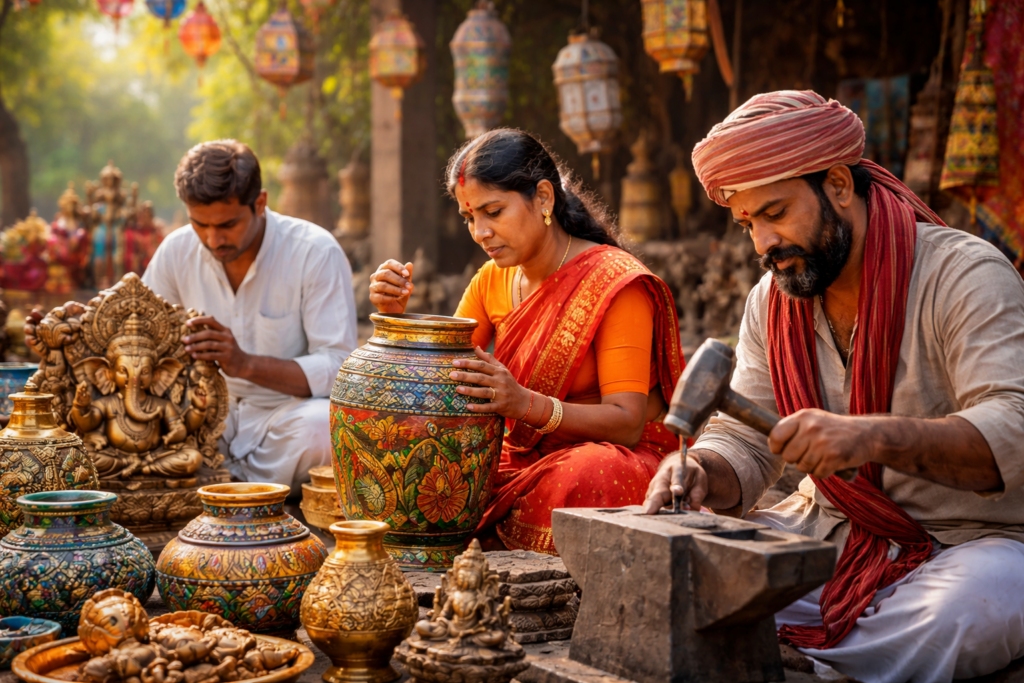
Who Are Indian Artisans?
Indian craftsmen are talented people and produce goods under the same techniques in a manufacturing process as the generations. The craftspeoples are dealt with handmade products comprising of house decorations, cloths, pots, jewelry among others.
In India, the artisanship is strong based in communities whereby the skills are passed on in families and enhanced with time. These customs are not merely professions but an aspect of life showing a strong attachment between the craftsman and the craft.
The majority of indian artisans are located in rural and semi-urban regions and they help in the local economies and maintain centuries old customs.
The Heritage of Indian Artisans
The Indian artisans can trace their history back to thousands of years. Out of the 3,000 forms of various crafts in India, each form represents a certain region, culture and community.
The special thing about indian artisans is that they can mix:
- Cultural heritage
- Spiritual values
- Regional identity
In their work, they are usually affected by religion, nature, and life. To most artisans, the craft is not merely a work, it is a very significant and even religious process.
Types of Crafts Created by Indian Artisans
There are a great number of crafts which Indian artisans work at. Among the most popular ones are:
1. Metal Craft
Artisans make decorative objects, sculptures, and serving utensils, out of such materials as brass, copper, and bronze.
2. Woodwork
Wooden furniture, decorations in the walls, and sculptures are handmade with detailed elaboration of craftsmanship.
3. Textiles
Starting with handwoven sarees, embroidered fabrics, and such like, textile artisans are one of the most renowned in India.
4. Pottery and Terracotta
Crafts made with clay consist of a decoration, kitchenware, and traditional figurines.
5. Handmade Home Décor
New websites such as Desire Panache are also devoted to the selection of hand-made indian artisans to create beautiful decoration combining tradition and the latest design.
These crafts bring out the variety and resourcefulness of indian craftsmen in various regions.
Why Indian Artisans Are Unique
The focus on the details, authenticity, and the emotional relation to work is the peculiar feature of indian artisans compared to mass production.
✔ Handmade Excellence
The products are made by hand, which makes them unique and of high quality.
✔ Generational Skills
These skills are transmitted within the families, and the traditional methods are maintained.
✔ Cultural Storytelling
Each composition is historical, cultural, and local.
✔ Sustainable Practices
Their work is environmental friendly since most artisans work with environmentally friendly materials and techniques.
Compared to the factory manufactured goods, handcrafted goods are personalized and can never be duplicated.
Role of Indian Artisans in Today’s World
Even with the modernization, the contribution of the indian artisans remains very important in:
- In order to preserve Indian culture.
- Supporting rural employment
- Marketing goods that are sustainable and ethical.
Nevertheless, most of the craftsmen are challenged by the lack of access to the market and the mass production of products.
Today, brands and platforms are trying to fill this gap by giving indian craftsman a better exposure, right price and global opportunities. This has been changing artisans to suit the contemporary markets and preserve their traditions.
Why Supporting Indian Artisans Matters
The Importance of Helping Indian craftsman.
Helping the indian craftsman is more than just buying a product, it is a bigger part of a larger cause.
When purchasing handmade products:
- You contribute to the survival of ancient crafts.
- You promote the artisan ways of living.
- You enforce sound morals and green consumption.
- You keep the culture to the generations to come.
The decision to purchase handmade items is a significant method to appreciate handicraft and artisanship in a world where factories dominate the production process.
Conclusion
India has a rich artistic and cultural heritage based on the Indian artisans. Their talents, imagination and effort have sustained ancient crafts over the centuries. Since ancient times in rural villages till nowadays in world markets, indian craftsmen are able to inspire their age old art pieces.
The need to produce handcrafted products is increasing as it would become more aware of quality, sustainability, and authenticity. When we buy the indian artisans, we get a chance to not only introduce some unique and meaningful pieces into our living rooms but also help preserve a legacy that helps to define India.
The decision to buy handmade is not only a matter of style, but of going beyond the conventions of the trend and supporting communities, as well as making a tribute to the spirit of craftsmanship.